Project Highlights
- Challenging layout due to reduced land availability.
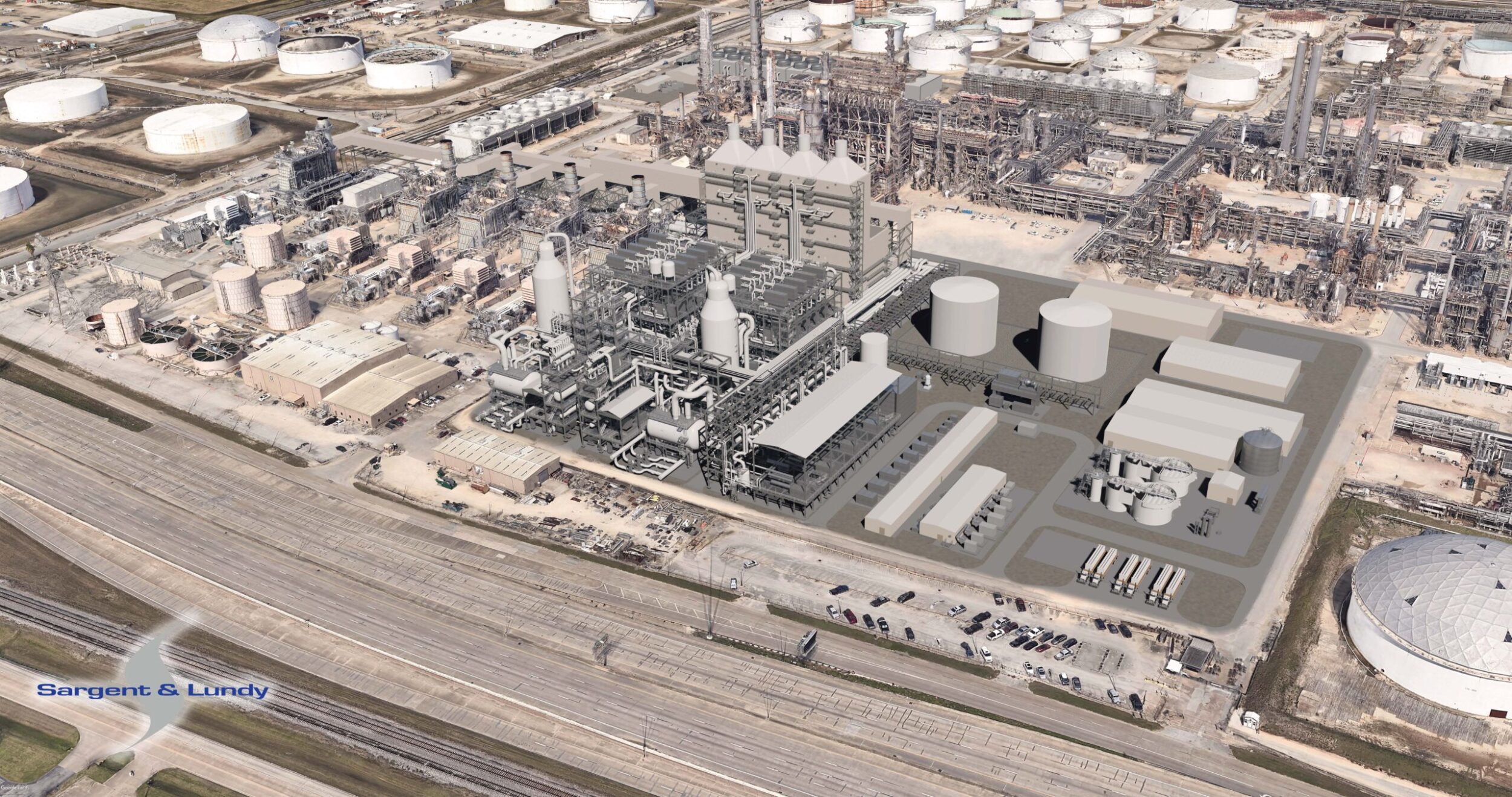
- Cogeneration facility is located in existing chemical manufacturing plant.
- Designed for treatment of flue gas from five natural gas combustion turbines.
- Used backpressure turbine for steam letdown and auxilliary power generation to minimize impacts on existing steam turbine and electrical system.
Project Description
Sargent & Lundy partnered with Calpine Texas CCUS Holdings, Shell Catalysts & Technologies, and Technip Energies to perform a DOE-funded FEED Study to integrate a new carbon capture system at Calpine’s Deer Park Energy Center (DKEC). The DKEC facility is a nominal 1200 MW, 5 x 1 natural gas-fired co-generation power plant situated at the Shell Chemical Manufacturing Facility. The DKEC facility produces steam for use by the adjacent Shell Chemical Manufacturing Facility as well as the onsite steam turbine for electrical generation.
The CCUS system consists of two equipment trains to process the combined flue gas flows discharged from the five unit combustion turbine/heat recovery steam generation trains. The carbon capture system is designed to treat typical full-load flue gas of approximately 19,970,000 lb/hr (or approximately 4,528,000 standard cubic feet per minute) of flue gas from all five combustion turbines combined. This equates to approximately 17,000 tonnes per day of CO2 captured, at a design capture rate of 95%. The FEED study has been performed considering a 90% plant capacity factor, which results in system sizing for approximately 5.6 million tonnes a year. This FEED study has assumed the CO2 is compressed to typical transport conditions and moved offsite to a dedicated sequestration facility.
Project Scope
Sargent & Lundy provided the following scope/services for this FEED study:
- Overall FEED study project management.
- Review of “Inside Battery Limit” designs.
- Engineering design for “Outside Battery Limits” or balance of plant systems.
- Engineering studies, including steam and power sourcing, water and wastewater treatment, cooling water supply & optimization, flue gas cooling options.
- Constructability review.
- Hazard and operability report, including facilitator and scribe roles.
- Project cost estimate.
- Develop consolidated FEED study report.
- Business case analysis, techno-economic analysis, life cycle analysis, environmental health and safety analysis, environmental justice analysis, economic revitalization and jobs creation outcome analysis.
Read more about our decarbonization services.
